
Sustainable

Home
Home
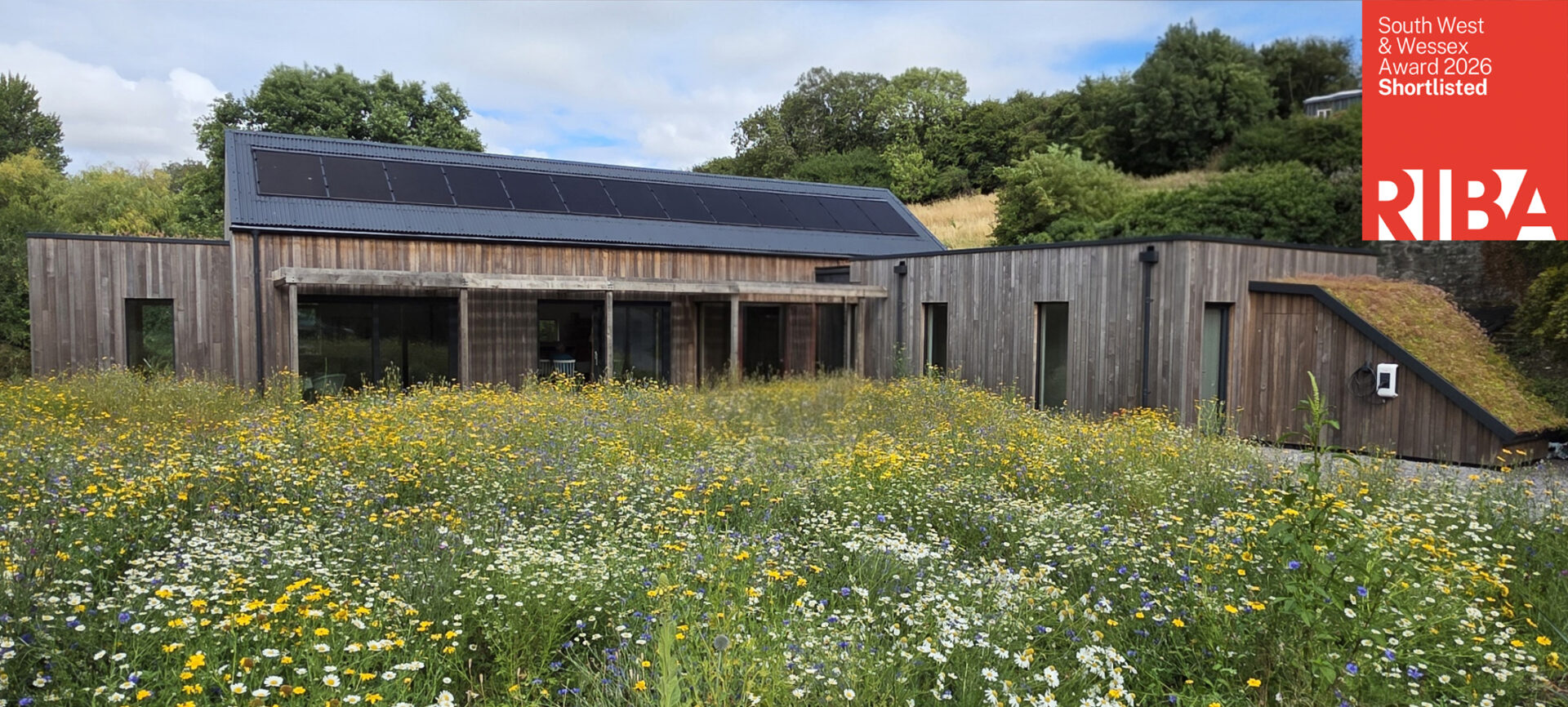
Set within a sensitive woodland and streamside location near Bath, this sustainable home employs a split-plan arrangement with two distinct wings—one accommodating private sleeping spaces, the other housing communal living areas—connected by a fully glazed link that reduces the perceived mass of the building and frames views across the landscape.
Built to exceptional environmental standards, the home achieves outstanding thermal performance through high levels of insulation, airtight construction, and renewable energy systems. Vertical timber cladding and corrugated metal roofing reference both the woodland setting and the agricultural vernacular of the Somerset countryside, whilst uncultivated gardens and a sedum roof enhance biodiversity and integrate the building into its rural context.
The combination of sustainable design quality and sensitive landscape integration secured planning permission via appeal for new residential development outside the village development boundary.
Short Listed for the RIBA South West Design Award
Project:
Meadow Bank
Location:
Bath, Somerset
Discuss Your project
Awards and Publicity

Shortlisted for the RIBA South West & Wessex Award 2026
View Slideshow


Project Details
The Client Brief
The clients sought a contemporary, energy-efficient home that would sit comfortably within its rural setting whilst delivering exceptional environmental performance. Beyond simply minimising running costs, the brief called for a residence that would actively enhance its immediate context through thoughtful landscape integration and ecological stewardship.
The design was to prioritise low environmental impact through strategic orientation, high-performance building fabric, and renewable energy systems. Material selection focused on sustainability, durability, and visual harmony with the surrounding landscape. The ambition was clear: to create a long-term, environmentally responsible home that supports modern living standards whilst meeting exemplary levels of architectural quality and ecological consideration.
Site Context and Challenges
The site presented several notable constraints that shaped the design response. Located within the garden of an existing dwelling, the plot’s riverside position required careful consideration of flood risk, whilst mature trees necessitated a building footprint that would avoid root protection zones and excessive overshadowing. A public footpath running nearby raised privacy concerns, and the site’s location outside the established development boundary of the village added significant planning complexity.
Securing planning permission required demonstrating that the proposed dwelling would not only avoid harm to the open countryside but would actively contribute positively to the local landscape character—a challenge that ultimately required determination through the planning appeal process.
Design Approach
The architectural strategy centres on a linear plan split into two discrete wings—one accommodating sleeping spaces, the other living areas—connected by a fully glazed circulation link. This arrangement reduces the perceived mass of the building, breaks down its scale to relate more comfortably to the domestic grain of the locality, and creates a dramatic internal threshold that frames views towards the woodland and stream.
The home achieves Passivhaus certification through exceptional levels of insulation, airtight construction, and a carefully integrated services strategy incorporating photovoltaic solar panels, an air source heat pump, and mechanical ventilation with heat recovery. This comprehensive approach ensures year-round thermal comfort with minimal heating demand and exceptionally low operational energy consumption.
Externally, the building employs vertical timber cladding and corrugated metal roofing—a material palette that references the agricultural buildings characteristic of the Somerset countryside. These materials have been selected to weather naturally, allowing the structure to sit quietly within the landscape whilst maintaining robust, long-lasting performance. A sedum roof and surrounding wildflower meadows further blur the boundaries between building and landscape, providing ecological habitat and visual integration.
Internally, tiled flooring provides a durable, contemporary surface that complements the home’s clean, minimal aesthetic and contributes to thermal mass for passive temperature regulation.
The Planning Journey
Gaining consent for a new dwelling in open countryside outside development limits presented the project’s principal challenge. The initial application faced resistance from the local planning authority, necessitating an appeal to secure permission. The success of the appeal rested on demonstrating the design’s exceptional quality, its positive contribution to landscape character, and its exemplary environmental performance—factors that collectively outweighed policy presumptions against rural development.
This outcome highlights the importance of design quality and contextual sensitivity in overcoming planning constraints, and demonstrates that well-conceived sustainable architecture can be recognised as an enhancement to the countryside rather than an intrusion.
The Outcome
Cooks Meadow stands as a demonstration of how rigorous environmental performance can be achieved without compromising architectural quality or contextual sensitivity. The Passivhaus certification delivers tangible benefits for the occupants through exceptionally low energy bills and superior internal comfort, whilst the building’s material palette and landscape integration ensure it sits comfortably within its rural Somerset setting.
The successful planning appeal validated the design’s approach, establishing a precedent for high-quality, sustainable residential architecture in sensitive countryside locations. The project illustrates that thoughtful design, material authenticity, and ecological consideration can combine to create contemporary homes that enhance rather than diminish their surroundings.
Key Features
- Passivhaus-certified performance with minimal operational energy demand
- Split-plan arrangement reducing building mass and maximising views
- Glazed link creating dramatic connection between living spaces
- Renewable energy systems including solar PV and air source heat pump
- Timber cladding and metal roofing referencing local agricultural vernacular
- Sedum roof and wildflower meadows enhancing biodiversity
- Successful planning appeal demonstrating design quality and contextual sensitivity
- Strategic orientation and high-performance fabric ensuring year-round comfort
What Our Clients Say About Us
MJW architects used their local knowledge and expertise to obtain a planning consent on a very contentious site. With considerable skill and experience in the design of low energy houses in rural settings it has proved valuable to us as clients to develop the design to our requirements. The result is a beautiful home constructed in sympathetic materials for its setting and built within our limited budget. It is a delight to live in as well as being the subject of many favourable comments from local people.Richard Barton
To discover how MJW Architects can help you with your architectural project or ideas, please click the button below and get in contact with us. We will be delighted to help you.
Get In Touch